

By: Jeremy Julian in partnership with EverPass Media
EverPass Media
For bars and restaurants, live sports remain one of the most reliable drivers of traffic, energy and repeat visits. When the right game is on, guests stay longer, spend more and come back.
That has not changed, and it’s not going to.
What has changed is how difficult it’s become for operators to consistently deliver the sports experience guests expect.
As media rights continue to shift across networks, streaming services, and exclusive distribution deals, operators are navigating a far more fragmented landscape than just a few years ago. What used to be simple is now a moving target, especially in commercial environments where not every service is licensed or built for restaurant use.
“Sports haven’t gotten less valuable. They’ve gotten more fragmented. And that fragmentation is what’s making it harder for operators to deliver a consistent experience.” said Bryan Icenhower, Chief Marketing Officer, EverPass Media.
The Challenge Is Bigger Than Fragmentation
Most operators already understand that the sports media landscape is more fragmented than it used to be. But the real issue is not just that games are spread across more places. It’s what that fragmentation creates inside the four walls of the restaurant.
Operators now have to manage which platform or service a game is on, whether there is an authorized commercial path to show it, whether the service works across multiple screens, and whether staff can get the right game on the right TVs quickly as the room fills up. That’s a very different reality than simply having the right package and turning the game on.
And for guests, none of that complexity is visible. They are not thinking about rights ownership, streaming exclusivity, or commercial licensing. They are thinking about one thing: can they watch the game here?
If the answer is no, or even maybe, that can quickly become a guest experience problem and a direct hit to revenue.
Why This Matters Even More During Football Season
This challenge becomes especially important during football season.
For many sports bars, dive bars, and neighborhood restaurants, NFL Sundays are not just another programming window. They are a core weekly business driver. They influence traffic, length of stay, food and beverage spend, group visits, and whether guests choose one venue over another.
That is why reliability matters so much.
If a guest walks in looking for an out-of-market game and the venue cannot confidently deliver it, that moment does not just create frustration. It creates doubt. And in a competitive market, doubt is expensive.
The Best Operators Are Treating Sports as Part of the Business
The restaurants navigating this shift most effectively are the ones that have stopped treating sports as passive background programming. They are treating sports as part of the operating strategy.
That does not mean turning every game into a major promotion. It means recognizing that, for many venues, sports are one of the clearest reasons a guest chooses to come in rather than stay home. Once that is true, the ability to deliver the game consistently becomes more than a technology issue. It becomes a business issue.
The operators who are adapting best are thinking more intentionally about which games matter most to their guests, whether they can show them legally and reliably, and whether managers and staff can execute under pressure. In many cases, the competitive advantage is not about having the most screens or the biggest budget. It is about making the experience feel simple for the guest.

Why Commercial-Ready Access Matters
One of the biggest misconceptions in the market is that if a game exists somewhere, it should be easy for a restaurant to show it.
That is not always the case.
In commercial environments, the standard is different. Restaurants are not just trying to locate a game. They need an authorized, reliable, scalable way to deliver it across a real operating environment, with multiple screens, busy service periods, and guests who expect it to just work.
That is where commercial-ready access becomes critical. It reduces uncertainty around what can and cannot be shown. It gives operators a clearer path to premium content. And it helps remove the last-minute scrambling that can undermine the guest experience at exactly the wrong moment.
A More Practical Path Forward
As this landscape continues to evolve, the operators who will be best positioned are the ones who make the experience feel simple for the guest, even if the backend has become far more complex.
That is exactly the kind of problem EverPass was built to solve.
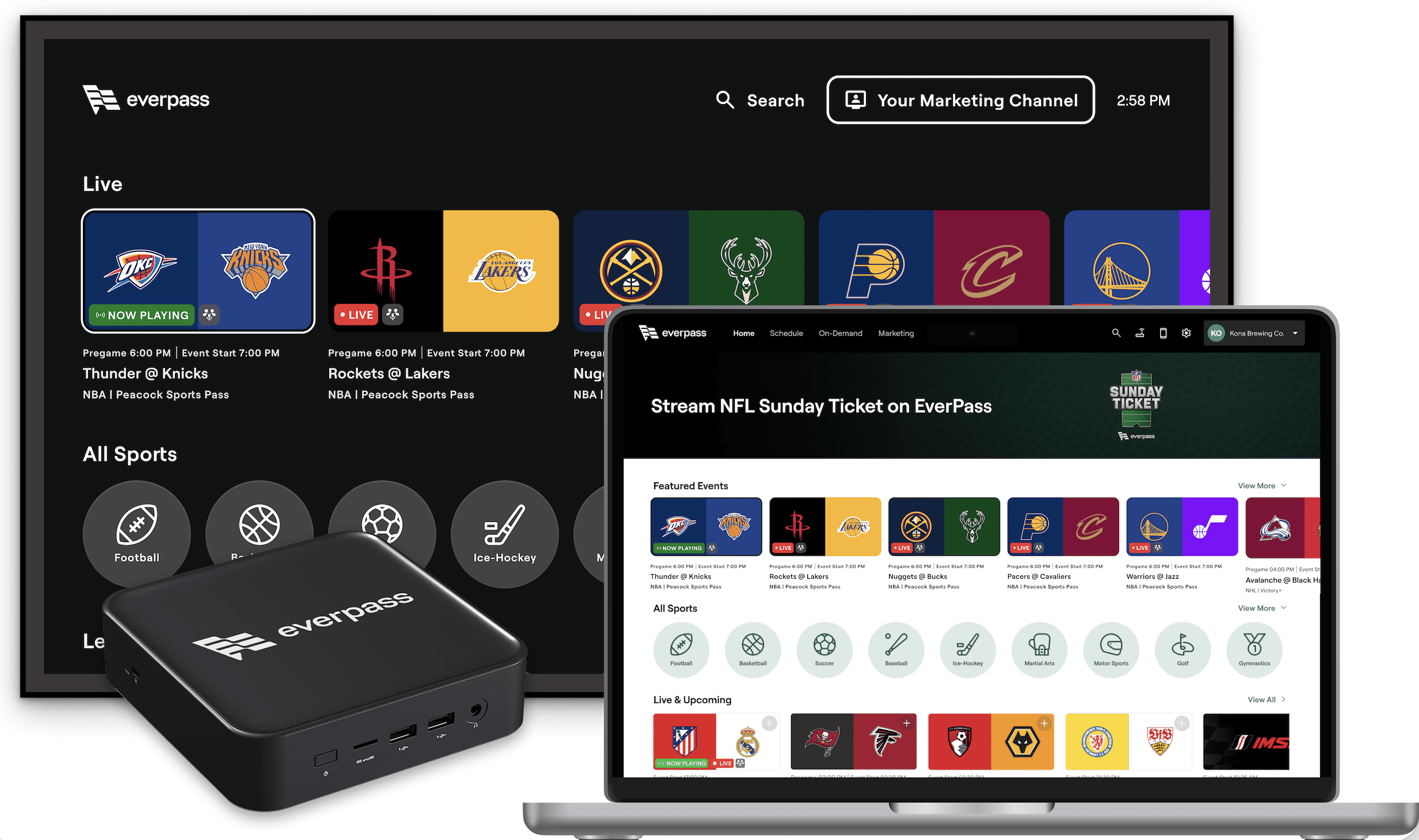
Rather than asking operators to piece together a shifting mix of providers and rights arrangements, EverPass was designed to give bars and restaurants a more reliable, authorized path to premium live sports in a way that actually fits how commercial venues operate.
That matters broadly across the sports landscape, but it matters especially with NFL Sunday Ticket.
For example, as the exclusive commercial provider of NFL Sunday Ticket, EverPass gives bars and restaurants the only authorized way to show every out-of-market Sunday afternoon game in a commercial setting. That removes a meaningful amount of friction from one of the most important programming windows of the week and gives operators something just as important as access: confidence.
“At the end of the day, guests don’t care how complicated the rights landscape has become,” said Icenhower. “They just want to know the game is on. The operators who can make that feel simple and dependable are the ones who are going to win.”
Final Takeaway
The sports media landscape is only getting more complex. Rights will continue to move. New platforms will continue to emerge. The distribution environment is not going back to what it was.
But the guest expectation is not changing.
Guests still want a great place to watch the game with friends, with energy in the room, and with confidence that their team will be on.
For restaurants, that creates both a challenge and an opportunity. The challenge is that delivering live sports is no longer as simple as it used to be. The opportunity is that the operators who solve that problem consistently, legally, reliably, and with less friction, will create a better guest experience and a stronger competitive advantage than the operators who do not.
THIS POST IS A PAID ADVERTORIAL
By : Jeremy Julian in partnership with EverPass Media


